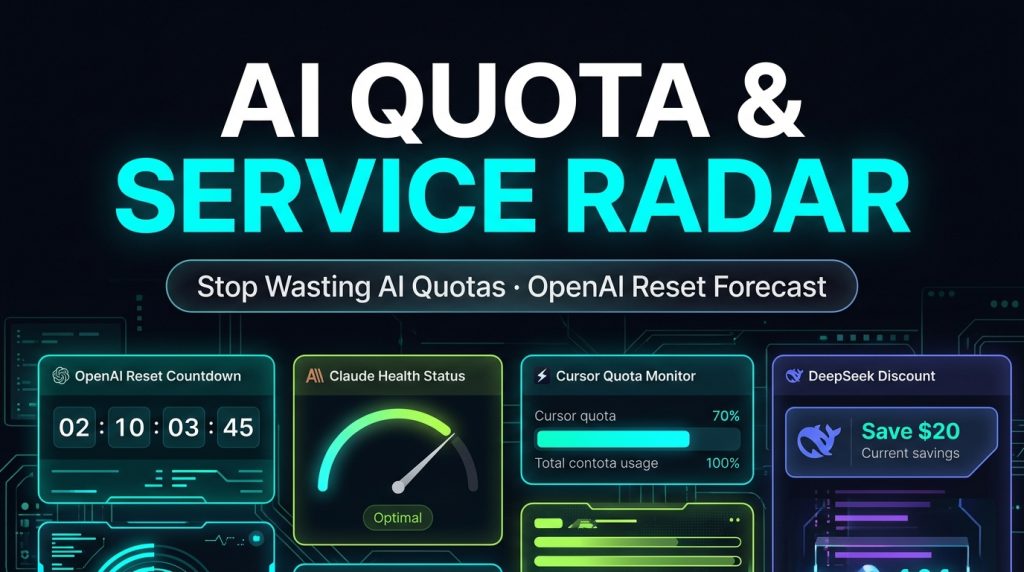
Stop Wasting AI Quotas: OpenAI Codex Reset Forecast & Model Health Radar
Orientation & Metadata
Author: Web Studio Engineering Team
Categories: AI Tools / AI Programming & Agents
Tags: OpenAI, Codex Reset, Claude 3.7, Cursor Agent, DeepSeek, MCP, AI Tools
Updated: September 2026
Direct Tool Access: Web Studio AI Quota & Service Radar
Key Capabilities: Real-Time Tweet Ingestion · LLM Semantic Analysis · Native Local Timezone Sync · Zero Data Uploads · Model Context Protocol (MCP) Ready
1. The Developer Dilemma: Ballooning Subscription Bills & Quota Expiration
For developers and engineers who rely daily on ChatGPT Plus / Team / Enterprise, Claude Pro, and Cursor, monthly AI tooling expenses frequently climb to $100 ~ $200+ USD. Over a year, this adds up to thousands of dollars in fixed compute costs.
Yet almost every heavy AI user encounters two intensely frustrating bottlenecks:
- Unannounced Quota Resets (Wasted Tokens):
Major AI labs (particularly OpenAI) periodically perform surprise, fleet-wide quota resets on Codex and reasoning models. When a reset hits, any unused high-speed allocation in your account is wiped out and refreshed. If you knew 18 to 24 hours in advance, you could easily schedule heavy code refactors, comprehensive test suite generation, or large data extraction pipelines to max out your quota before it resets. - Unexpected Rate Limits & Silent API Degradations:
Right in the middle of a complex coding session, Claude suddenly returns a “5-hour rate limit reached” error, or an AI gateway suffers silent service degradation. Queries hang, code completions time out, and your entire engineering flow is derailed.
The Core Problem: Why isn’t there a real-time, zero-configuration “weather radar” for AI compute that warns developers before quota resets, converts everything to your local timezone, and continuously tracks upstream service health?
To solve this exact frustration, Web Studio has launched a dedicated free utility: The AI Quota & Service Radar.
2. Under the Hood: Predicting Surprise Resets 18 to 24 Hours Early
How is it possible to anticipate an OpenAI quota reset when there is no public schedule?
The Radar operates on a continuous, multi-layer monitoring and evaluation pipeline:
┌────────────────────────┐      ┌────────────────────────┐      ┌────────────────────────┐      ┌────────────────────────┐
│  01 Real-Time Ingest   │ ───> │  02 LLM Semantic Eval  │ ───> │  03 Historical Cycle   │ ───> │  04 Active Alerts      │
│  Lead Eng @thsottiaux  │      │  Parse cues & patches  │      │  Compute 7.2-day avg   │      │  Web / Telegram / MCP  │
└────────────────────────┘      └────────────────────────┘      └────────────────────────┘      └────────────────────────┘
1. High-Signal Targets: Tracking Lead Infrastructure Engineers
OpenAI infrastructure lead Tibbo (@thsottiaux), who oversees Codex and coding agent allocation, frequently drops subtle hints on X (Twitter) immediately before and during quota refreshes:
* Infrastructure hotfix deployment: Mentions of production token allocator patches (“Pushed a hotfix to production token allocator…”);
* Milestone celebrations: Community growth milestones (e.g., crossing 30M developers) that often coincide with promotional quota resets;
* Contextual jokes & wordplay: Enthusiastic updates hinting that they “never slept so well, feeling completely reset”.
2. Fast Semantic Inference & Confidence Scoring
Captured tweets are streamed in milliseconds into a high-speed LLM inference pipeline. The model cross-references signals against 49+ historical reset cycles (averaging every 7.2 days, heavily skewed toward Friday nights and month-end dates) to calculate an objective 0–100 probability score and estimated reset window.
3. Native Browser Timezone Alignment (Zero UTC Mental Math)
Unlike legacy tools that force users to calculate UTC or US Eastern offsets, the Radar uses the browser native Intl.DateTimeFormat API. It automatically detects your local IANA timezone (PST, EST, CET, GMT+8, etc.) and displays exact local countdowns and target time windows.
3. Core Feature Matrix
╔════════════════════════════════════════════════════════════════════════╗
║                   ⚡ Web Studio AI Quota Radar Feature Matrix          ║
╠════════════════════════════════════════════════════════════════════════╣
║ 🎯 Pillar 1: OpenAI Codex Surprise Reset Forecast (Probability & Clock) ║
║ 🧠 Pillar 2: Claude 5-Hour Sliding Window & Service Health Indicator   ║
║ 💻 Pillar 3: Cursor Agent Monthly Quota Refresh & Overage Guard        ║
║ 🐳 Pillar 4: DeepSeek Daily Off-Peak 50% Off Window Tracker            ║
║ ✨ Fun Touch: "Beg for Reset" Community Counter & Particle Fireworks   ║
║ 🔌 Pro Power: Native Model Context Protocol (MCP) Protocol Integration ║
╚════════════════════════════════════════════════════════════════════════╝
1. OpenAI Codex Surprise Reset Forecast
- Direct Access: https://blog.757688.xyz/tools/ai-radar
- Visual Presentation: Styled in high-contrast Neo-Brutalism with bold borders. The hero card showcases the real-time reset probability (e.g.,
>85% Imminent) along with a second-by-second countdown to the target window. - Real-World Verification:
Today, the system picked up Tibbo tweet: “And of course, a reset is also landing by midnight today.” The semantic classifier immediately elevated the reset probability to 98% with 99% confidence, giving developers worldwide a 6-hour advance window to consume remaining premium quotas.
2. Claude 5-Hour Sliding Limit & Degradation Radar
Anthropic Claude models (Sonnet 3.7 / Opus) offer extraordinary coding capabilities but enforce strict 5-hour rate windows. The radar tracks upstream API health and community report velocity, highlighting degradation risks before your session suddenly gets throttled.
3. Cursor Agent Quota Cycle & Overage Guard
Cursor Agent (Pro, Pro+ 3x, Ultra 20x, and usage-based billing) burns multiple queries per complex codebase refactoring. The Radar provides a clear 1st-of-the-month reset countdown and helps you budget agent usage efficiently.
4. DeepSeek Daily Off-Peak 50% Discount Monitor
The official DeepSeek API features a lucrative nightly off-peak discount policy:
* Daily 50% Off Window: 00:30 to 08:30 UTC+8 every single day. During this period, all input and output token prices across all DeepSeek models are halved (50% discount);
* Standard Pricing: 08:30 to 00:30 UTC+8;
* Radar Value: Instantly see whether the 50% off window is active and track the countdown to the next discount period. Developers can defer token-heavy batch processing, synthetic data generation, and large embedding pipelines to this window, instantly slashing API bills by half.
4. Three High-Impact Real-World Workflows
Workflow A: The Pre-Reset Sprint (Full Quota Utilization)
- Trigger: Radar indicates Codex Reset Probability > 80%.
- Action: Launch queued resource-heavy jobs that you typically reserve—such as batch generating TypeScript typings across 20+ legacy projects, generating end-to-end integration tests, or building full architectural documentation before the slate is wiped clean.
Workflow B: Batch Ingestion at 50% Lower Cost
- Trigger: Monitor the DeepSeek off-peak discount window.
- Action: Schedule batch synthetic data synthesis, repository vectorization, and knowledge graph builds to execute between 00:30 and 08:30 UTC+8, securing direct 50% token cost savings while dodging peak daytime traffic.
Workflow C: Local Agent Autopilot via MCP
- Setup: Connect the Radar directly to Cursor, Windsurf, or Claude Desktop via the Model Context Protocol (MCP):
- Cursor / Windsurf (SSE Remote Stream): Add to your
mcpServersconfiguration:
json

    {

      "mcpServers": {

        "radar": {

          "url": "https://blog.757688.xyz/tools/api/radar/mcp"

        }

      }

} - Claude Desktop / Antigravity (stdio Bridge): Connect directly using standard stdio bridges.
Your local agent can autonomously query: “When is the next anticipated Codex reset?” or “Is DeepSeek in the 50% discount window right now?” for autonomous compute scheduling.
5. Frequently Asked Questions (FAQ)
Q1: Is the Web Studio AI Radar completely free?
Yes. The Radar is part of the Web Studio productivity toolkit. It is 100% free to use, requires no registration, and has no hidden fees or paywalls.
Q2: Does the tool collect my API keys or personal credentials?
No. The Radar requires zero API keys, logins, or personal credentials. All probability analysis and timezone conversions occur on public infrastructure data and client-side browser logic.
Q3: Does the countdown adjust to my local timezone outside of Asia?
Yes. The app automatically detects your system IANA timezone (whether EST, PST, GMT, CET, or JST). All countdowns and reset estimates are dynamically displayed in your exact local time.
Q4: What does the “Beg for Reset” button do?
It is a playful community tribute to the original tool. Clicking it triggers an interactive confetti explosion and increments both a local and shared community counter to blow off steam while waiting for resets.
Q5: How can I receive real-time push alerts?
Bookmark the Radar for instant access, or join the dedicated Telegram channel linked in the notification modal to receive automated alerts whenever reset probability exceeds 80%.
6. Web Studio Online Toolbox Directory
╔════════════════════════════════════════════════════════════════════════╗
║                     🛠️ Web Studio Developer Toolkit                     ║
╠════════════════════════════════════════════════════════════════════════╣
║ 🌐 Tool Suite Hub: https://blog.757688.xyz/tools                       ║
║                                                                        ║
║ 🌟 Featured Developer & Creator Tools:                                 ║
║   • ⚡ AI Quota & Service Radar: https://blog.757688.xyz/tools/ai-radar
║   • 🖼️ Client-Side Media Batch Compressor: https://blog.757688.xyz/tools/image-compressor
║   • 🍏 iPhone HEIC to JPG Converter: https://blog.757688.xyz/tools/heic-converter
║   • 📄 Browser-Native PDF Swiss Knife: https://blog.757688.xyz/tools/pdf-tools
║                                                                        ║
║ 🛡️ Privacy Promise: Zero Uploads · No Sign-Up · 100% Free & Fast       ║
╚════════════════════════════════════════════════════════════════════════╝
About The Author