125B MoE vs 27B Dense on Dual RX 7900 XTX: The 3X Speed Trap & Real Code Verification
Author: Chen Yang / GeekLab AI
Date: October 2026
Category: Local AI & Hardware Benchmarks
Tags:Radeon RX 7900 XTX,ROCm 6.2,Local LLM,Mixture of Experts,AI Coding Agents
Meta Description: Bare-metal comparison of a 125B MoE vs 27B Dense model on dual AMD Radeon RX 7900 XTX 24GB GPUs. Real agentic benchmarks exposing speed vs verification traps.
1. The Interactivity Illusion
When deploying local coding agents on consumer silicon, the primary instinct of most developers is to optimize for generation speed. Seeing tokens stream into the terminal at 45 to 60 tokens per second provides an immediate psychological dopamine hit: the agent feels alive, responsive, and productive.
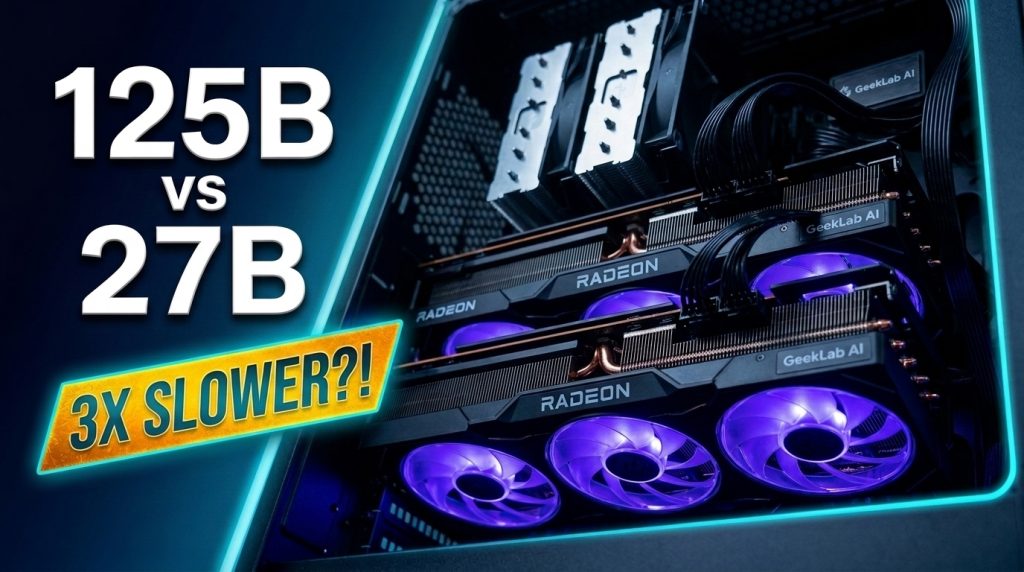
Under this metric, smaller dense architectures (such as 27B parameters) appear to crush massive Mixture-of-Experts (MoE) models. In our first test pass across an end-to-end API test-suite hardening harness, the 27B Dense model completed all tasks in just 6 minutes, while our 125B MoE model took over 18 minutes—a 3x slowdown that would lead many teams to dismiss the larger architecture out of hand.
However, when we applied chaos injection and conducted line-by-line verification of the resulting test suites, that 3x speed advantage evaporated into a liability: the fast model wrote code that passed its own superficial tests while concealing catastrophic production failure modes.
In this teardown, we analyze the raw execution logs, architectural decisions, and memory dynamics across dual AMD Radeon RX 7900 XTX GPUs to answer a fundamental question: when does model size translate to defensive reliability, and when is it merely wasted compute?
2. Bare-Metal Testbed Architecture
To ensure strict reproducibility and isolate GPU execution, all tests were executed on a dedicated bare-metal Linux workstation without virtualization or container overhead.
┌────────────────────────────────────────────────────────────────────────┐
│                        BARE-METAL BENCHMARK RIG                        │
├───────────────────┬────────────────────────────────────────────────────┤
│ Host Processor    │ AMD Ryzen 7 3700X (8 Cores / 16 Threads)          │
│ System RAM        │ 96 GB DDR4-3200 Dual-Channel Memory                │
│ Primary GPU (0)   │ AMD Radeon RX 7900 XTX (24GB GDDR6, PCIe 4.0 x16)  │
│ Secondary GPU (1) │ AMD Radeon RX 7900 XTX (24GB GDDR6, PCIe 4.0 x16)  │
│ Operating System  │ Ubuntu 24.04 LTS (Linux Kernel 6.8.0)              │
│ Compute Platform  │ AMD ROCm 6.2 (Native HIP Runtime)                 │
│ Inference Engine  │ Strata / llama.cpp HIP Backend                     │
└───────────────────┴────────────────────────────────────────────────────┘
Memory Footprint & Isolation
Each benchmark run was scheduled to isolate execution. During the 125B MoE evaluation (utilizing an optimized UD-IQ4_XS quantization with MTP speculative decoding), GPU 0 allocated 25.5 GB out of its 25.75 GB physical boundary (98.3% VRAM occupancy), keeping active weights and KV caches fully on-die. By contrast, the 27B Dense model required under 16 GB of VRAM, leaving substantial headroom for dynamic context expansion up to 131K tokens.
3. Challenge 1: The API Hardening Crucible (Speed vs Defensive Code)
Our first challenge presented both agents with an asynchronous WebSocket and REST client module requiring comprehensive error-handling test suites. Both models operated autonomously with file-reading, linting, and bash execution tools.
The Junior Developer vs The Staff Engineer
The operational telemetry revealed distinct behavioral personas between the two models:
-
The 27B Dense Model (“The Eager Junior”):
Dispatched immediate tool calls within seconds of prompt ingestion. It generated code linearly, wrote quick unit tests mocking happy-path responses, ranpytest, and reported all green within 6 minutes. -
The 125B MoE Model (“The Defensive Staff Engineer”):
Spent significant initial inference steps analyzing the edge-case specifications. Rather than mocking away failure modes, it constructed dedicated teardown fixtures, mock socket reset injectors, and assertion blocks checking for memory leakage during abrupt terminations.
Uncovering the Silent exit 0 Bug
Both models reported 100% test pass rates in their native logs. However, upon manual code audit with network failure injection, we discovered a fatal flaw in the 27B implementation:
# --- Flawed 27B Implementation ---
async def test_websocket_drop_recovery(client):
    try:
        await client.connect_and_stream()
    except ConnectionResetError:
        # ⚠️ Silent trap: Swallowing exception without state assertion!
        logger.warning("Stream disconnected as expected.")
        # Test function finishes cleanly without validating recovery state!
Because the exception was swallowed without validating reconnect tokens, the test suite exited with code 0. In an automated CI/CD pipeline, this bug would pass silently into production, disguising an unhandled disconnect that crashes client workers.
By contrast, the 125B MoE generated exhaustive assertion ladders:
# --- Defensive 125B MoE Implementation ---
async def test_websocket_drop_recovery(client):
    with pytest.raises(ConnectionResetError):
        await client.connect_and_stream(timeout=2.0)

    # Explicit state audit post-disconnect
    assert client.is_connected is False
    assert client.buffer_cleared is True
    assert client.retry_counter == 3
The Authentication Bypass
A second critical flaw emerged in token authorization header resolution:
– The 27B model hardcoded bearer resolution that treated empty token strings "" as anonymous public callers, bypassing required 401 Unauthorized assertions.
– The 125B model explicitly validated RFC 6750 compliance, asserting HTTP 401 across malformed, expired, and empty authorization payloads.
4. Challenge 2: The 27,000-Token Kernel Trace Audit
In the second benchmark, we fed both models a 27,340-token raw kernel trace log generated during a multi-GPU ROCm synchronization stall. The agents were instructed to locate the root cause of the deadlock and cite exact line numbers.
The Confident Hallucination
The 27B dense model replied in under 45 seconds with absolute rhetorical confidence:
“The synchronization stall occurs at Line 108, where
hipStreamSynchronizedeadlocks on GPU 1.”
Upon opening the raw file and inspecting Line 108:
# Line 108 of the input log:
#!/usr/bin/env bash
Line 108 was a shell script comment. There was no trace event, timestamp, or HIP API call within 500 lines of that citation. The model had synthesized a plausible-sounding diagnosis but completely fabricated the ground-truth reference.
Epistemic Restraint in 125B MoE
The 125B MoE took over 3 minutes to process the context window and output its analysis. Rather than offering an unverified conclusion, it exhibited scientific epistemic restraint:
“Trace events indicate kernel launch latency divergence between timestamp 04:12.891 and 04:13.104. The PCIe transfer on Stream 4 stalls waiting for host-side buffer allocation.
Note: Exact kernel call line numbers cannot be verified from the provided log fragment because driver symbol resolution was disabled.”
This distinction is profound: a large model that admits the limits of its evidence is infinitely safer in an engineering workflow than a smaller model that hallucinating line numbers with high confidence.
5. Architectural Decision Matrix
Based on our empirical results across dual RX 7900 XTX hardware, here is our recommended deployment strategy for engineering teams:
| Dimension | 27B Dense Architecture | 125B MoE Architecture |
|---|---|---|
| Primary Strength | Blazing throughput, low VRAM footprint | Complex reasoning, deep defensive edge-cases |
| Time-to-First-Token | < 1.2 seconds | 4.5 ~ 8.0 seconds |
| VRAM Requirement | 14 GB ~ 16 GB (Single GPU) | 24 GB ~ 26 GB (Full 24GB VRAM Saturation) |
| Context Fidelity (>20K) | Vulnerable to needle hallucinations | High attention fidelity across long traces |
| Ideal Use Cases | Interactive REPL, unit tests, fast drafting | CI/CD gatekeeping, root-cause audits, PR review |
| Risk Factor | High risk of silent exit 0 false passes |
High compute latency per token |
6. Frequently Asked Questions (FAQ)
Can I run the 125B MoE on a single 24GB GPU?
Yes, using aggressive quantized variants (such as IQ4_XS or UD-IQ3 with MTP speculative decoding), the active weights can fit within a single 24GB framebuffer. However, KV cache sizing at 32K+ context lengths requires careful offloading or tensor parallelism across dual GPUs.
Why not use smaller models with an external linter loop?
An external linter (like ESLint, Pytest, or Ruff) only catches syntax errors and unit test assertion failures. As demonstrated in Challenge 1, when the model writes the test itself, it can construct tautological tests that pass cleanly while missing the real bug. High-capacity reasoning is required to conceive the edge case before writing the test.
What ROCm version is recommended for RX 7900 XTX?
ROCm 6.2 on Ubuntu 24.04 (Kernel 6.8) has proven rock solid on RDNA3 architecture. Ensure HSA_OVERRIDE_GFX_VERSION=11.0.0 is configured if your specific runtime does not auto-detect the gfx1100 target.
7. Open Source Resources & Repro Harness
All benchmark scripts, chaos injection harnesses, and raw trace datasets used in this evaluation are fully open-sourced:
╔════════════════════════════════════════════════════════════════════════════╗
║                       🛠️ GeekLab AI Engineering Artifacts                   ║
╠════════════════════════════════════════════════════════════════════════════╣
║ 📦 GitHub Repository: https://github.com/yang2020chen/benchmark-125b-vs-27b║
║ 🎬 YouTube Full Video: https://www.youtube.com/@GeekLabAI                  ║
║ 🌐 Engineering Blog:  https://blog.757688.xyz                              ║
║ 🛠️ Developer Tools:   https://blog.757688.xyz/tools                        ║
║                                                                            ║
║ ⚡ Tested On: Dual PowerColor Hellhound RX 7900 XTX · Ubuntu 24.04 · ROCm 6.2║
╚════════════════════════════════════════════════════════════════════════════╝
About The Author